HOW TO USE LORIKEET SECURITY TO TURN COMPLIANCE INTO A SALES ENGINE
★Turn Security From Cost Center to Competitive Signal
In the next five minutes, you’ll see how to turn security from a checkbox into a sales accelerator and risk reducer. Lorikeet Security is an offensive security and compliance platform that unifies manual penetration testing, 24/7 attack surface monitoring, audit automation, and employee training in one portal. Bottom line: if you sell software and security is a growth constraint, this is a Quality Pick that consolidates vendors, tightens remediation loops, and shortens your path to trust.
★The Business Case
In my 15 years building and buying security programs, what separates leaders from laggards is cycle time: time-to-find, time-to-fix, and time-to-prove. Lorikeet compresses all three. Their 100% manual testing avoids the false-positive drag of scanner-led shops, their continuous monitoring keeps deltas small between tests, and their audit automation (SOC 2, ISO 27001, PCI-DSS, HIPAA, and more) turns findings into audit-ready artifacts. That convergence reduces engineering rework, eliminates “audit theater,” and advances enterprise sales faster.
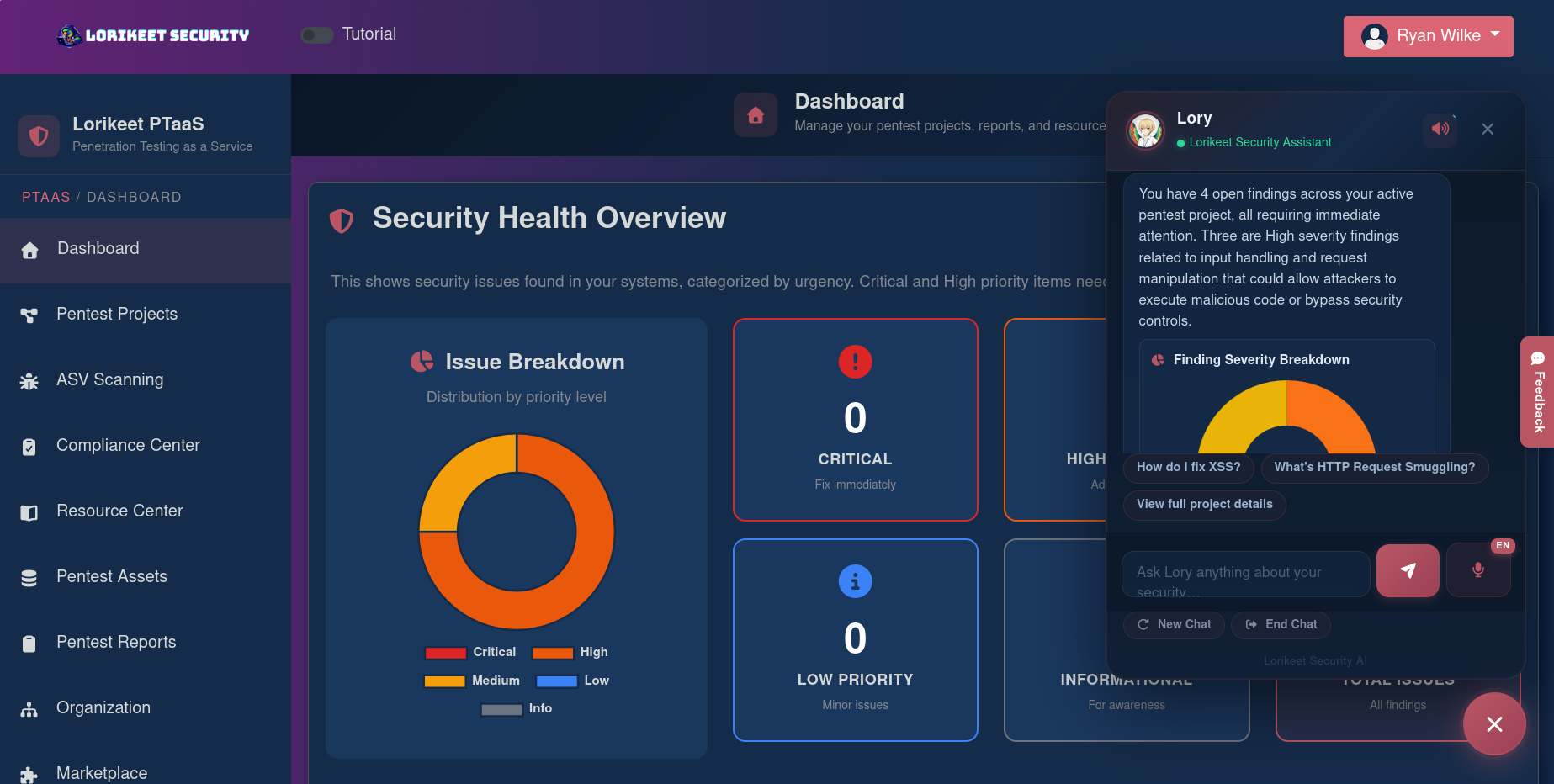
Market positioning matters. Many vendors sell point solutions; Lorikeet sells outcomes: verified fixes via free retesting, developer- and auditor-ready remediation, and a real-time portal (with Lory, their AI assistant trained on ~2,000 vulns) that operationalizes the work, not just reports it. The competitive advantage shows up where it counts—fewer slipped releases from last-minute findings, fewer procurement stalls over security questionnaires, and stronger diligence signals in fundraising and M&A. If “Build Quality Analysis” is your North Star, this platform aligns incentives from code to close.
★Key Strategic Benefits
-
Operational Efficiency: Lorikeet’s live portal centralizes engagements, attack surface telemetry, compliance status, and collaboration—reducing swivel-chair time across tickets, spreadsheets, and PDFs. Developer-ready steps (and free retesting) tighten MTTR by converting findings to fixes without translation overhead.
-
Cost Impact: Consolidation replaces multiple vendors—pentest firm, scanner subscription, awareness training, and compliance consultant—with one program. Fewer false positives mean fewer wasted sprints; faster audit readiness accelerates enterprise revenue and reduces deal friction penalties.
-
Scalability: Coverage spans web, APIs, mobile, desktop, AI agents, cloud, AD, containers/Kubernetes, and specialized red teams—so as your footprint grows, your methodology and evidence remain consistent. Integrations with Vanta and Drata plus CPA attestation partners let you scale from readiness to certification without switching providers.
-
Risk Factors: Success still hinges on your remediation velocity—vendor findings don’t fix code. Manual-first testing is a strength, but schedule accordingly to avoid late-cycle surprises; align test windows with release trains. Ensure data handling agreements cover sensitive environments (e.g., prod replicas, PHI, card data).
★Implementation Considerations
Plan a phased rollout. Week 0–2: scope assets, environments, and compliance targets; align on test depth (apps, APIs, infra), red team rules of engagement, and change windows. Week 2–6: execute manual testing while enabling attack surface monitoring; create a remediation lane in your backlog with SLAs by severity. Week 6–12: retest fixes, finalize evidence, map controls (SOC 2/ISO/PCI), and route to your Vanta/Drata workflows; coordinate CPA attestation via Accorp for fast-track audits.
Resource-wise, you’ll need an engineering lead to triage/remediate, a security owner (or vCISO) to own risk decisions, and a compliance coordinator. For high-sensitivity environments, include platform SREs to stage safe tests. Change management is critical: publish a comms plan, define “stop-the-world” criteria for red team ops, and require “definition of done” to include remediation evidence. Integration lift is modest—ticketing (e.g., Jira), identity (for access reviews), and cloud accounts for scoped testing. Expect first value in weeks, full program stabilization in one to two quarters.
★Competitive Landscape
While Flowtriq excels at instant DDoS detection and auto-mitigation to keep servers online during volumetric attacks, Lorikeet Security is better suited for proactive, breadth-first security and compliance maturity. Flowtriq is an edge defense product for SRE/infra teams; Lorikeet is a platform for CISOs, product, and eng leaders who need manual pentesting, continuous exposure management, and audit evidence in one place. If uptime during attacks is your acute pain, Flowtriq is a sharp, specialized tool.
Where Lorikeet differentiates: 100% manual testing (no scanner dump), free retesting, AI-assisted triage, and full-spectrum coverage—including AI agent assessments and “vibe coding” reviews for apps built with tools like Lovable, Claude Code, and Cursor. What others won’t tell you: many shops resell scans as “pentests.” Lorikeet’s manual-first model is a Premium Alternative designed to surface business-logic flaws scanners miss, which is where real breach and brand risk hide.
★Recommendation
If security is gating enterprise deals or audits, treat Lorikeet as a Quality Pick. Pilot on one critical product and one compliance framework; measure MTTR, false-positive rate, and sales-cycle speed before/after. Assign an exec sponsor, set remediation SLAs, and calendar retest windows. Maintain Flowtriq or equivalent for DDoS-specific uptime; use Lorikeet to build the program that prevents, proves, and sells security. Slop Alert: avoid “PDF-only pentests”—they cost less upfront and more everywhere else.
✨ END OF BROADCAST ✨
🚀 READY TO EXPERIENCE THE FUTURE?
VISIT LORIKEET SECURITY →