WHY CLARI'S REVENUE INTELLIGENCE ACTUALLY MATTERS FOR MODERN SALES
★Revenue Signals Engine: why Clari is more than a CRM dashboard
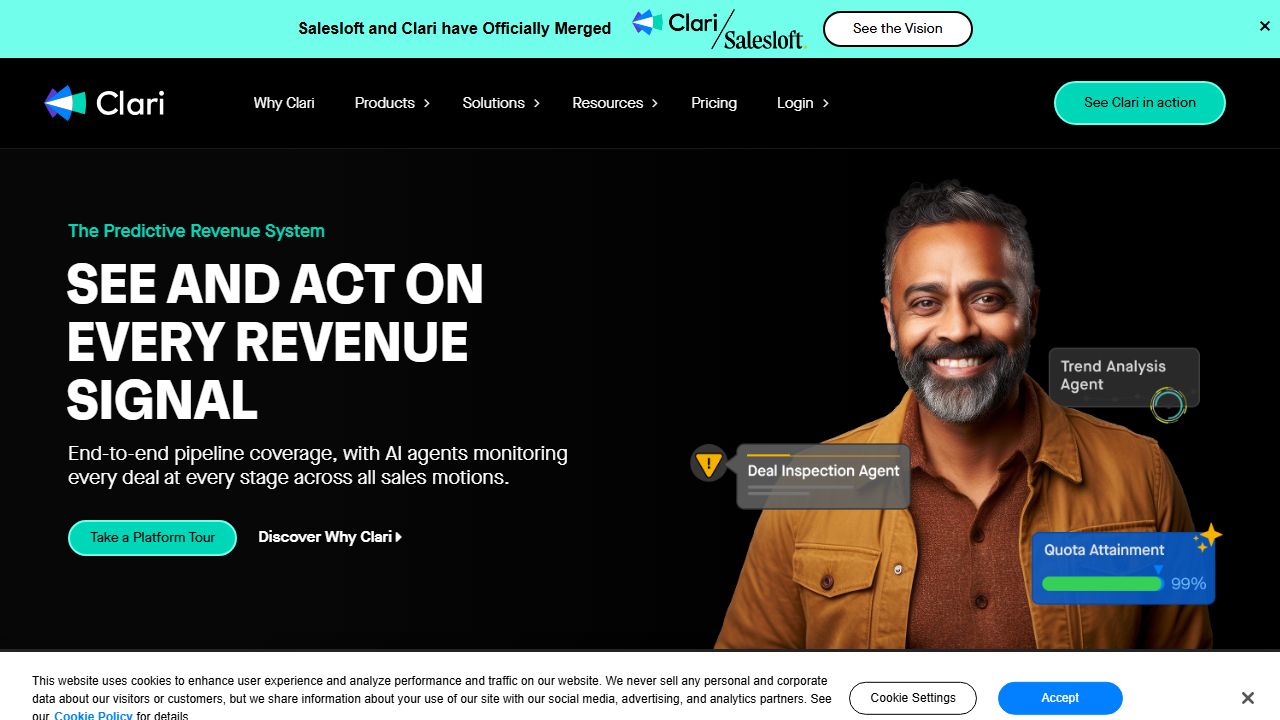
Teams that adopt revenue orchestration report up to an 80% reduction in manual work — and that stat cuts to the core of why Clari exists. In my 15 years in SaaS I’ve seen point tools pile noise on top of noise; Clari’s pitch is different: unify signals, not just data, into a revenue context layer that powers AI agents. Technically that means a stream-first ingestion fabric, a unified revenue graph, and an ML/agent layer that reasons over signals (emails, calls, CRM events, activity logs, forecast adjustments) to predict outcomes and automate actions. The design philosophy favors orchestration over analytics: act where revenue happens, not just report on it.
★Architecture & Design Principles
Clari’s stack reads like modern enterprise SaaS: event-driven ingestion, a canonical revenue data model, microservices for orchestration, and a model-serving layer for inference. Practically that looks like message streams (Kafka-style) ingesting CRM changes, activity events, and third-party signals; a transformation layer that builds a revenue graph (entities: account, opportunity, contact, cadence, forecast snapshot); and ML agents that subscribe to graph events to detect risk and recommend actions. Key decisions favor near-real-time insights (low-latency streaming + incremental model scoring), multi-tenant isolation with strict RBAC, and a workflow engine to execute cadence steps. Scaling is horizontal — sharded storage for tenants, stateless inference nodes, and warehouse syncs for heavy analytics.
★Feature Breakdown
Core Capabilities
-
AI Revenue Agents: These are configurable model-backed services that operate on the revenue graph. Technically they combine supervised forecasting models, anomaly detectors, and sequence models over activity streams to flag at-risk deals or to surface next-best actions. Use case: auto-flag a 90-day stale opportunity and push a cadence action to the rep’s queue with suggested messaging.
-
Revenue Cadences & Workflows: A declarative workflow engine maps cadences to events and roles. Think state machines + task queues: when an agent emits a “risk” event, a cadence can spawn tasks, create CRM activities, and trigger notifications. Use case: orchestrate renewal outreach across AE, CSM, and Finance with SLA timers and escalation paths.
-
Forecasting & Revenue Insights: Combines time-series models with ensemble forecasting over opportunity-level signals and rep behavior. The technical differentiator is contextual features (engagement score, product mix, payment history) rather than raw pipeline totals, giving probabilistic outcomes and scenario simulations. Use case: run “what-if” changes to quota attainment by adjusting close probabilities programmatically.
Integration Ecosystem
Clari emphasizes broad connectivity: first-class connectors to major CRMs (Salesforce, Microsoft Dynamics, HubSpot), calendar/email ingestion, telephony/call transcript integrations, and warehouse syncs (for analytics backfill). APIs and webhooks expose graph events and workflow triggers — enabling reverse-ETL patterns and custom orchestrations. In practice, you’ll map your CRM as the source of truth and let Clari enrich and return actionable metadata.
Security & Compliance
Enterprise deployments expect encryption in transit and at rest, granular RBAC, SSO (SAML/OIDC), and comprehensive audit logs — Clari implements these controls and supports contractual data processing agreements. For regulated environments you’ll want to validate the vendor’s published compliance certifications and any regional data residency options during procurement.
★Performance Considerations
Real-time inference and low-latency event processing are central. Model scoring at scale requires autoscaling inference clusters and smart caching of computed signals to avoid repeated heavy recomputation. Heavy customers offload historical analytics to a warehouse (e.g., Snowflake) and use Clari for live orchestration to balance cost and latency. Expect warm-up costs for ML models and tune backpressure on event streams during bulk ingests.
★How It Compares Technically
While Armatic excels at billing, invoicing, and collections workflows with accounting-first integrations, Clari is better suited for enterprise-scale revenue orchestration across go-to-market functions. Armatic’s technical surface is optimized for financial ops (AR automation, payment rails) and typically has a simpler implementation path and pricing profile for SMBs. Clari’s stack invests in deep signal fusion, probabilistic forecasting, and workflow automation for CROs and RevOps teams managing complex deals across many stakeholders.
★Developer Experience
Clari exposes REST/GraphQL-like APIs, webhooks, and SDKs for common languages; documentation is aimed at RevOps and engineering partners with sandbox environments and professional services for complex integrations. The learning curve is non-trivial: you’ll need data modeling discipline and a mapping layer to align your CRM schema with Clari’s revenue graph.
★Technical Verdict
Strengths: deep signal fusion, configurable AI agents, and a workflow-first architecture make Clari powerful for enterprises that need predictable revenue orchestration. Limitations: implementation complexity, data hygiene requirements, and the operational overhead of maintaining model-informed workflows. What others won’t tell you: the ROI hinges on process discipline — the platform amplifies good ops and exposes bad ones. If you’re a CRO or RevOps leader at scale and you want orchestration (not just analytics), Clari is a quality pick; if your core need is billing/collections automation, Armatic may be a leaner technical fit. Curating quality in a sea of mediocrity means choosing the tool that matches the maturity of your processes — Clari rewards organizations ready to invest in that maturity.
✨ END OF BROADCAST ✨
🚀 READY TO EXPERIENCE THE FUTURE?
VISIT CLARI →